


Changeover
Switching the line from the last product to yours


Small batch, low MOQ, no minimum: every manufacturer words it differently, and few publish a figure. Here is how the number is calculated, what affects it, and which batch sizes Merywood works with.
Merywood starts at 2,500 units for white label and 5,000 units for private label across supplements, skincare and pet products alike. The minimum exists because preparing a production line costs roughly the same whether it fills 500 units or 5,000, so the setup is spread over however many units you order. Merywood works as a contract manufacturer: manufacturing and labelling are carried out on partner production lines to your brief, while Merywood places and controls the order and supplies the batch documentation. If you are weighing a first trial batch, the trial batch section is the part worth reading.
What a minimum order quantity is actually made of
Switching the line from the last product to yours
Washing down and validating that nothing carries over
Weighing, blending and documenting every input
Setting the machine for your capsule, jar or sachet
Plates, proofs and the first approved label run
Each of these is paid once per batch on the partner production line. None of them gets cheaper when the batch is small.
A minimum order quantity is not a sales tactic. It is arithmetic about a production line. It is worth hearing from someone with no stake in this page. A contract cosmetics manufacturer put it plainly in a public discussion about launching a skincare brand with 500 units:
“I currently operate a contract cosmetic manufacturing facility, and as a result, I cannot accept orders that fall below the minimum order quantity. This is because the energy expended to produce 500 units is the same as that required for 5,000 units; consequently, such orders result in a loss rather than a profit for the company.”
Contract manufacturer, r/PrivateLabelSellers, 26 June 2026 · source
Changeover, cleaning and validation, raw material preparation, filling tooling and print setup happen once per batch on the partner line. That cost does not shrink with the batch. It just lands on fewer units.
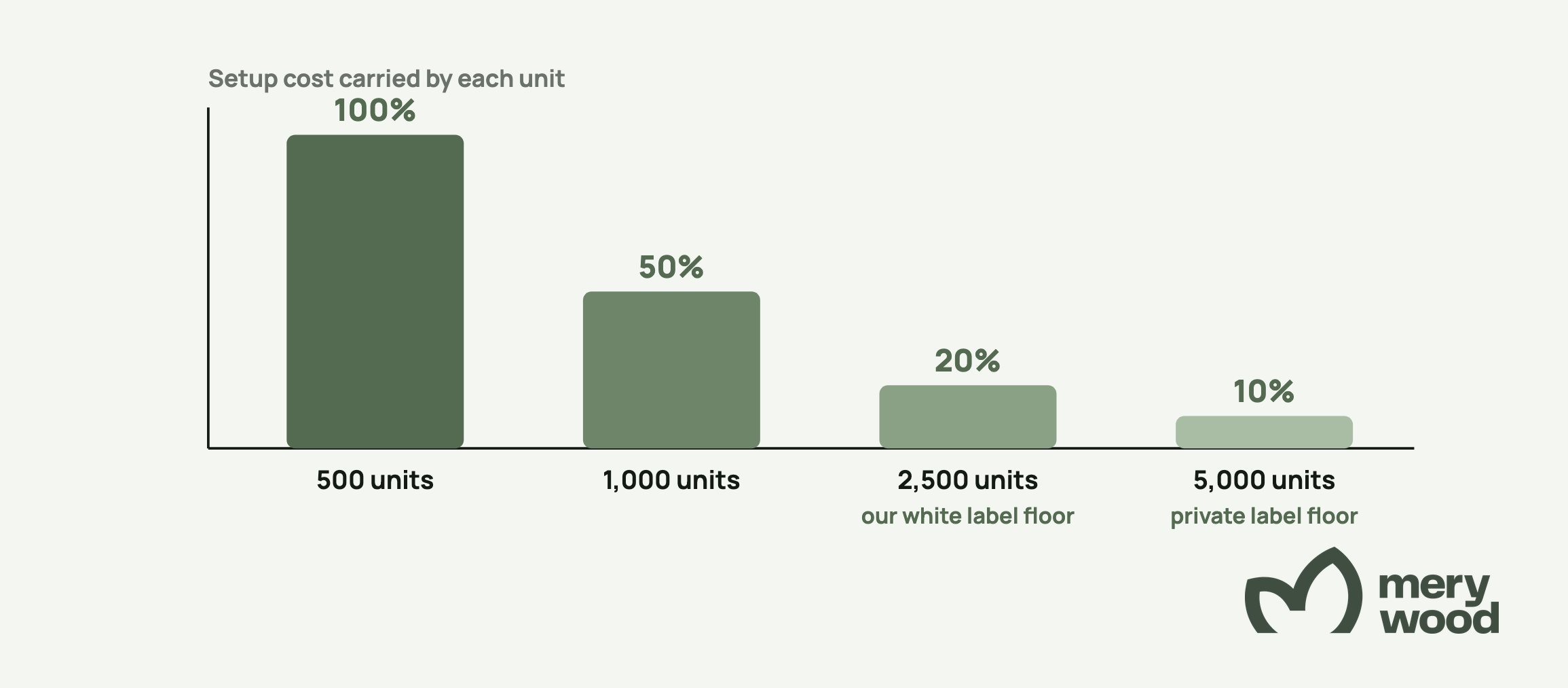
Schematic, not a price list. The proportions follow from one fact: on the partner production line, changeover, cleaning, validation, filling tooling and print setup are paid once per batch regardless of its size.
2 projects at the same volume can sit at different minimums. 4 things explain most of it.
Capsules, tablets and powder are the most stable. Liquids take longer
A standard jar holds the minimum. A custom tin does not
A rare ingredient carries its own supplier minimum
Across the industry, October to December is the congested quarter
Capsules, tablets and powders are where we are strongest and where minimums are most stable: there are many lines, demand is steady, and production time is short. Liquids take longer, and the equipment is less forgiving. You can see the full range on our private label supplements and private label cosmetics pages.
A standard jar or bottle keeps the minimum where it is. Custom packaging does not. A bespoke tin, a double-walled box, a magnetic closure or screen printing means buying materials specially, and that moves both the minimum and the lead time.
Common ingredients are usually available at short notice. An unusual one is not. It may carry its own supplier minimum. Add 4 to 5 weeks of waiting.
October to December is the congested quarter. Lines, printers and ingredient suppliers tend to be at their busiest before Black Friday and the New Year.
Setup costs the same whether the line fills 500 units or 5,000

Worth knowing before the brief: if you already know your markets, say so before production starts. At Merywood, a single contract manufacturing run can carry several label designs, so each market gets its own label from the beginning rather than a relabelling job later.
These are order minimums for finished goods carrying your label, stated per product rather than per order. 2 other figures are sometimes confused with them: the minimum for a bespoke formula, which is set by the partner production line that makes it, and the minimum for a custom label or print run, which is set by the printer. Both are confirmed in writing for your project before you commit.
A minimum in units tells you half the story. What you commit to is an order value. That is the number worth comparing between suppliers. On a rough estimate, a standard format in standard packaging lands at 1.80 to 2.80 EUR per unit, which puts the two floors here.
Indicative as at October 2026. Not a quote. The band is net of VAT and covers the finished units only: delivery, storage, duties, artwork and product notification are not in it. 4 things move it: the formula, the packaging, the order volume and the raw materials. A bespoke tin or an unusual ingredient can lift the unit price well above the band; a repeat order at higher volume pulls it down. Ask for a written quotation against your own specification that states exactly what it covers.
Published minimums in contract manufacturing vary by more than two orders of magnitude, so a number on its own means little. At one end, large European contract manufacturers publish minimums in the hundreds of thousands of units for loose capsules, tablets and stick packs, and a few thousand for blisters in cartons. Merywood sits at 2,500 and 5,000 for finished packed goods.
That gap is not a judgement on anyone. It is scale. A plant built for half a million units is cheaper per unit. It is also the wrong plant for a first launch. One that will run 2,500 costs more per unit and gets you to market. So the useful question is not who has the lowest number. It is which tier your project belongs in. Worth asking any manufacturer for the figure that applies to your own form and packaging rather than a headline number, because the two are rarely the same.
Tell us the form, the market and the volume you have in mind. We will come back with the minimum and the lead time for that specific case, not a range.
Sometimes. It is a commercial decision, not a rule. 2 things decide it: whether the production line can carry the short run and whether the project is likely to grow.
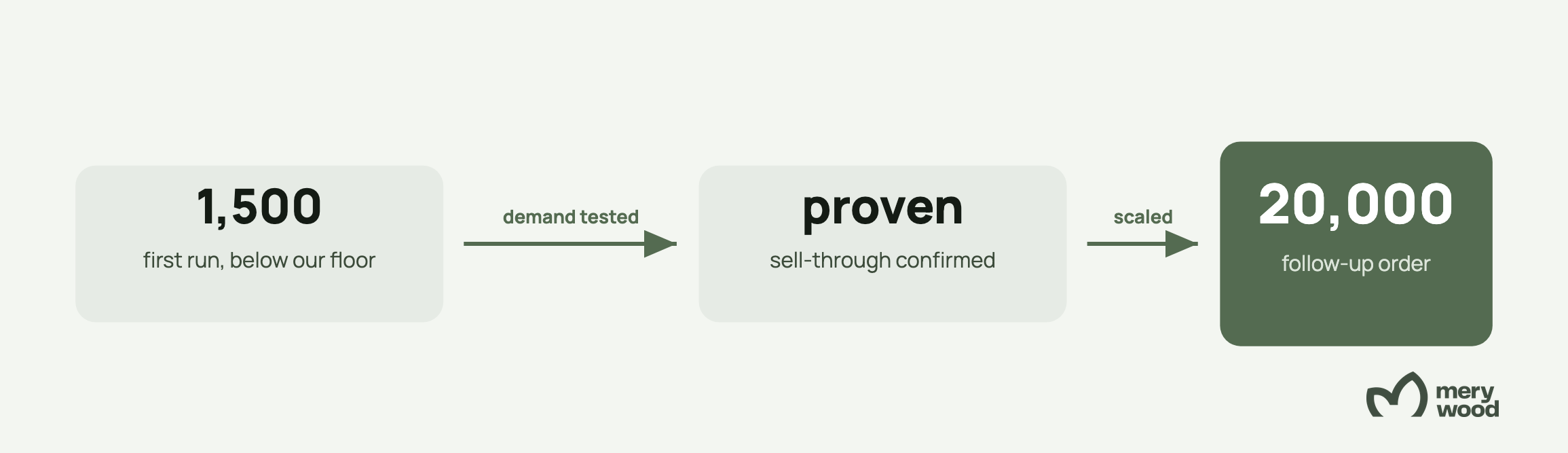
One case from our own order book shows the shape of it. A joint-care capsule brand would not commit to a large batch first. They wanted proof of demand. They started with 1,500 units, below our floor. Once sell-through was confirmed, they came back with a follow-up order of 20,000 units.
A second case ran the same way: a supplement in a custom metal tin launched at 1,500 units, with tins from China and capsule formulation and final assembly in the Netherlands.
What makes the answer yes is rarely the size of the first order. It is whether there is a plan behind it. A manufacturer answering the same question in public put it this way:
“In our experience, the bigger challenge isn’t manufacturing 500 units—it’s having a clear customer acquisition plan before production starts. Brands that already have a community, email list, or creator partnerships usually perform much better with small production runs.”
r/PrivateLabelSellers, 26 June 2026 · source
There is a trade. A short run costs more per unit. The setup you are paying for has not changed.
One honest note on fit. If your first run is genuinely 300 to 500 units and you want to test a market before committing, we are not the right partner and we will say so on the first call. Smaller white-label specialists and B2B marketplaces such as Wonnda are a more reasonable place to start looking for that tier. Coming back at 2,500 once the product has sold is a better use of your money than squeezing a run that costs more per unit than it should.
In the fourth row, it is worth being exact, because it surprises first-time brands. Under EU law the responsible person is the company that places the product on the market, which is normally the company whose name appears on the pack. Merywood works as a contract manufacturer: the manufacturing and the labelling are carried out on partner production lines to your brief, and we supply the batch documentation and the permitted claim wording checked against the EU register. The rules themselves differ by category. Cosmetics follow Regulation 1223/2009 and its responsible person. Food supplements follow the notification rules of each country of sale. Pet products follow the feed rules. Ask which set applies to your own product rather than working from one general answer. Product notification in the country of sale can be done by you, or we can take it on as a separate service.

Every batch leaves with its documentation, whatever the run size
The smallest batch a manufacturer will run for one product. It exists because the cost of preparing the line is the same whatever the batch size, so below a certain quantity, the run does not cover its own setup.
2,500 units for white label and 5,000 units for private label. The same figures apply to supplements, skincare and pet products.
Sometimes. It depends on the production schedule and on whether the project is likely to scale. We have run a first batch of 1,500 units. The unit cost on a short run is higher because the setup cost has not changed.
Per product. 3 variants of the same formula are three separate runs, each with its own changeover and cleaning. The 2,500 and 5,000 figures are order minimums for finished goods under your label; where a bespoke formula has to be made on a partner line with a higher minimum of its own, that figure is confirmed for your project before you commit.
5 to 7 weeks from a signed brief on a catalogue formula with your label, including production, packaging and quality control. The shortest lead time is 2 to 3 weeks when materials are in stock.
No. Samples are produced separately and cost 150 EUR for white label and 300 EUR for private label, net of VAT and excluding delivery.
No. Both sit at 2,500 units for white label and 5,000 units for private label. What differs is lead time: capsules and tablets move faster than liquid forms.
Sports bars and sports protein, animal jellies, pressurised aerosols, and functional or energy drinks. Each requires either a high minimum order quantity or expensive raw materials, making small runs unworkable.
Not medical advice. This article explains how minimum order quantities are calculated in contract manufacturing and what Merywood’s own minimums are. Merywood is a contract manufacturing company, not a medical one. We do not diagnose or treat anything, and nothing here is a statement about the effect of any product.


