

How Are Collagen Supplements Made? From Raw Materials to Finished Powder


How Are Collagen Supplements Made? From Raw Materials to Finished Powder


Walk into a well-run collagen plant in the EU and the first thing that registers isn’t the equipment. It’s the smell. Bouillon, old leather, the back wall of a fishmonger — depending on what went into the tanks that morning. It is not the part most consumer-facing product pages describe first.
That smell is the answer to a question most consumer-facing collagen content skips over: where the stuff comes from, and how it lands tasteless in a tub with a pastel label and a clinical-looking dosing spoon.
This piece is for the people who actually need the answer. Brand owners. Formulators. Anyone squinting at a Certificate of Analysis trying to work out what half the line items mean. How is collagen powder made on an industrial scale today, step by step? Below — the parts most product pages leave out.
Not medical advice. This article explains how collagen supplements are made and manufactured for educational and informational purposes only. It does not describe how to use any supplement, or cosmetic, and it is not medical, clinical, or regulatory advice. Talk to a qualified healthcare professional before using any collagen product, and consult the applicable regulations in your market before manufacturing or selling one.
Why Anybody Makes Collagen in the First Place
Collagen is the most abundant protein in the human body. Roughly a third of your total protein. The scaffolding under your skin, the tension in your tendons, the matrix inside your bones, the elastic webbing across the other connective tissues that hold you together. Take it away and joints lose cushion, skin loses bounce, broken bones knit slower, and paper cuts take a few extra days to forget about you.
The body manages fine through your twenties. After that, things quietly tip. Collagen production drops roughly 1% per year. Hormones shift, UV piles up, smoking accelerates the slide, a low-protein diet doesn’t help. By the time aging skin starts to crease in the mirror, the underlying collagen fibers have already thinned, frayed, or cross-linked into something with the spring of overcooked rubber. Less collagen production at the cellular level shows up as thinner dermis, weaker cartilage, slower wound repair. That visible side of skin aging funds the entire collagen market.
Oral collagen supplements run on a single premise: hand the body a concentrated dose of the amino acids needed for collagen synthesis, plus the signaling peptides that may prod fibroblasts back toward useful activity. Whether the body actually plays along is a more nuanced question. We’ll get to it.

Key Point: Collagen supplements do not deposit collagen anywhere under the skin’s surface. They drop off raw materials, and in the case of specific collagen peptides, signaling fragments. What gets built — and where — is up to your own cells.
What the Molecule Actually Looks Like
Picture a length of mooring rope. Three polypeptide chains, each about a thousand amino acids long, twist around one another, locked together by hydrogen bonds. That is native collagen. The chains run unusually heavy on three amino acids (glycine, proline and hydroxyproline), and that amino acid composition is what gives the triple helix structure its tensile strength.
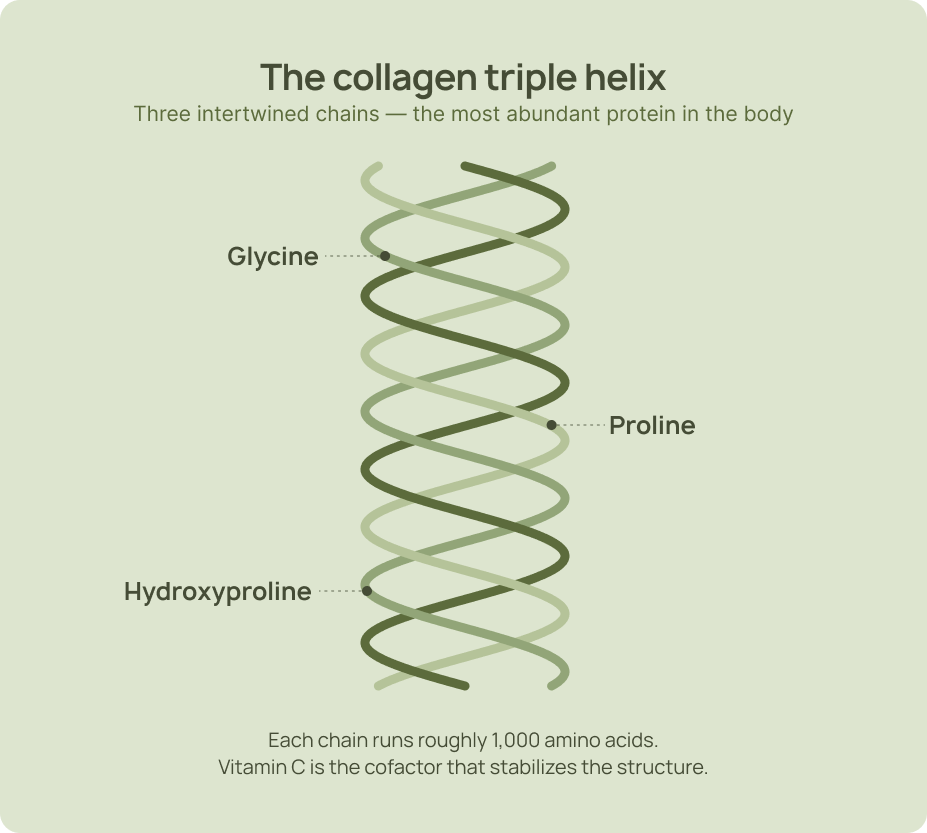
Three intertwined polypeptide chains form the triple helix. Each chain runs about a thousand amino acids long. In tissue, these triple helices stack into collagen fibrils. The fibrils braid into the thicker collagen fibers visible under a light microscope. The result holds a tendon together against pulling forces that would snap a steel cable of comparable diameter. Engineers admire it. Materials scientists study it. Your body has been quietly producing it since you were an embryo.
The same collagen structure also explains why raw collagen does very little when eaten as-is. The molecular structure is far too large to cross the digestive tract intact. Before the human body can absorb native collagen, manufacturers have to undo work that biology spent millions of years perfecting.
How collagen protein is made inside the body is one story. Ribosomes translate procollagen chains, enzymes hydroxylate residues, the helix self-assembles outside the cell. The factory side is the inverse — take finished animal tissue and reduce it, stage by stage, to fragments small enough to drink. How is collagen protein made into a consumer-ready powder? Through the six stages below.
Where the Raw Materials Actually Come From
Industry estimates put roughly three-quarters of the world’s collagen powder on cattle. Bovine hides, split hides, and beef bones — material that would otherwise leave the abattoir as fertilizer or pet food. The volume of leftover bones from any large abattoir is the quiet reason the industry runs primarily on cattle in the first place. The rest is pigs, fish, poultry, and a small but rapidly interesting slice of fermentation-derived “vegan collagen.” Each source carries its own collagen types, its own amino acid composition, and its own consumer perception issues.
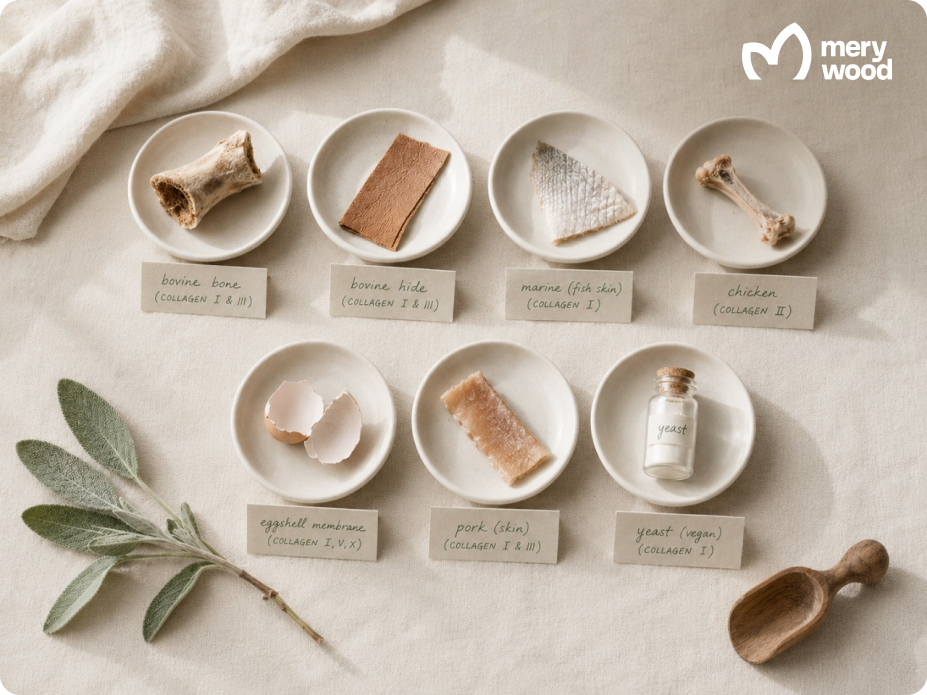
Seven sources of collagen
Bone broth, the analog version of all this, sits outside the modern pipeline but deserves a mention. Simmer animal bones for 12 to 48 hours and you pull gelatin plus a few smaller peptides directly into the cooking water. The yield depends on how much marrow and connective tissue clings to the bones at the start. Protein content from one batch to the next swings wildly. The flavor doesn’t survive coffee.
Plant proteins (pea protein, rice protein) cannot supply true collagen. Collagen is a family of fibrous proteins that only animals build. Yeast and bacteria can be engineered to express it. Lettuce cannot. Products marketed as plant-based collagen are usually amino acid blends paired with vitamin C and silica, designed to support collagen production rather than replace it. That’s a perfectly defensible approach, as long as the label says what the product actually is.
 Insight: Recombinant collagen produced from genetically modified yeast is structurally similar to human collagen — the yeast express engineered collagen sequences. At current prices, though, it sits well above bovine, which is why you’ll find it in private label cosmetics night creams more often than in a 250-gram supplement tub.
For brand owners, the source decision is not just a formulation choice. It shapes taste, allergen labeling, the documentation a contract manufacturer needs to provide alongside every batch, and the claims a finished product can legally support in the EU market. The right choice depends on positioning, target audience, and regulatory ambition more than on chemistry alone.
How Collagen Powder Is Made: The Step-by-Step Process
So how do you make collagen powder that actually performs in a finished SKU? Six broad stages. The chemistry varies plant to plant. The logic doesn’t.
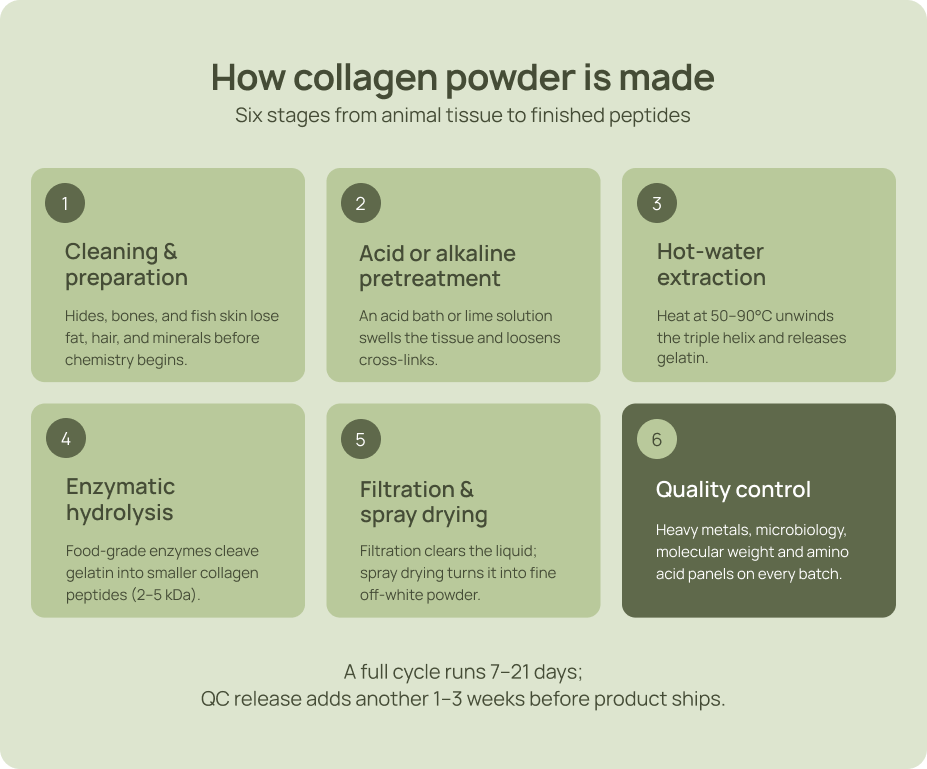
Step 1: Cleaning and Preparation
Raw material arrives frozen or salted. Hides. Bones. Fish skin. Fish scales. Before any chemistry begins, everything that isn’t collagen has to go:
- Fat and lipids — degreased mechanically and with food-grade surfactants
- Hair and scales — pulled off with depilation chemistry or scraped mechanically
- Non-collagen proteins — washed out with dilute alkali or acid rinses
- Minerals — bones drop into dilute hydrochloric acid until only the collagen-rich ossein is left behind
- Microbial load — managed with cold storage and chlorinated water rinses
Skip the detail work here and the smell follows the product to the consumer. A fishy aftertaste in a finished marine collagen tub almost always traces back to insufficient defatting in week one.
Step 2: Acid or Alkaline Pretreatment
The cleaned material then sits in either an acid bath (typical for porcine and fish-skin lines) or an alkaline lime solution, the standard route for bovine hides. The pretreatment runs anywhere from hours to days. It swells the tissue, breaks the cross-links between collagen molecules, and prepares the protein for extracting collagen in the next stage.
The acid-versus-alkaline call is not aesthetic. Alkaline-treated bovine collagen ends up with a slightly different amino acid composition and a different residual ash than acid-treated marine collagen pulled from the same starting weight. The differences in bovine collagen sourced via these two routes are small but real. Formulators who care about taste, color, or the precise dipeptides downstream pick a route before the first batch ships.
Step 3: Hot-Water Extraction
The pretreated material then moves into stainless-steel extractors filled with hot water at 50–90°C. Heat unwinds the triple helix and releases gelatin — collagen that has lost its native fold but stays a long, intact protein. Same gelatin that ends up in gummy candies and capsule shells.
A manufacturer can stop here and dry the gelatin. Many do. Gelatin is still a much larger market by tonnage than collagen peptides, and per-ton margins on the food side are usually friendlier. For a powder that dissolves in cold liquid and absorbs cleanly, though, the work continues.
Step 4: Enzymatic Hydrolysis
Gelatin meets food-grade proteolytic enzymes that cleave the long chains into much shorter fragments — collagen peptides. The output is hydrolyzed collagen, sometimes labeled collagen hydrolysate.
Enzyme choice shapes the peptide profile:
- Papain — from papaya. The workhorse for high-volume bovine peptide lines. Produces a broad molecular weight range.
- Bromelain — from pineapple stem. Often paired with papain on marine collagen to soften any residual fish notes.
- Microbial proteases (Alcalase, Flavourzyme) — bacterial or fungal enzymes that allow tighter molecular weight targeting for premium SKUs.
- Custom enzyme blends — proprietary mixes used by contract manufacturers chasing specific bioactive dipeptides.
Tuning enzymatic hydrolysis is the hardest skill on the floor. Too little exposure and the peptides stay too large — they gel in the fridge and absorb badly. Too much and the protein over-digests into free amino acids, costing you the bioactive peptide fragments that some research links to skin and joint outcomes. On a commercial line, the window between underdone and overdone is measured in minutes.
Most collagen peptide supplements target an average molecular weight between 2 and 5 kilodaltons. Premium collagen products built around clinically studied skin benefits often specify a tighter range, or a particular dipeptide like prolyl-hydroxyproline.
Step 5: Filtration, Concentration, and Spray Drying
So how do they make collagen powder out of what is, at this point, an unflattering brown soup? Filtration, mostly. The solution runs through ultrafiltration, ion exchange, occasionally activated carbon — pulling out residual fats, salts, anything that carries odor or color. The cleaned liquid then evaporates under vacuum until it’s a syrup. From there it goes into the spray dryer.
(The first time I saw a spray dryer running at full tilt, I genuinely assumed something inside had caught fire. They are loud, hot, and look mildly apocalyptic from the floor. They are also one of the best pieces of equipment ever designed.)
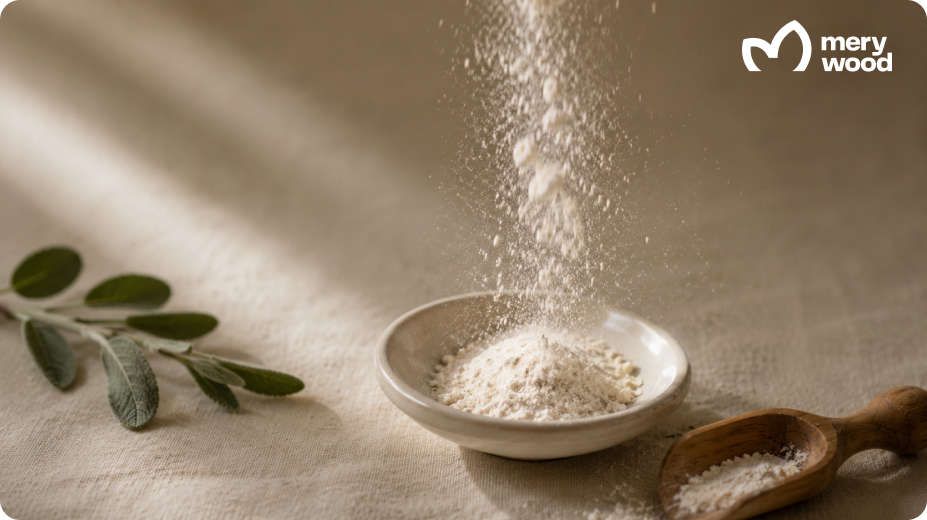
A nozzle atomizes the syrup into a tower of hot air. The water flashes off in seconds. What lands at the bottom is fine, off-white collagen protein powder at 90–95% protein content. From there — how is collagen protein powder made into something a customer recognizes — it’s finishing work: sieve, blend the batch into uniformity, fill the foil-lined bags that ship to the supplement industry.
Step 6: Quality Control
Before any batch ships, samples leave the line and go to the lab. A serious QC panel covers:
- Heavy metals — lead, mercury, cadmium, arsenic (marine collagen gets the closest scrutiny here)
- Microbiological load — total plate count, yeasts, moulds, Salmonella, E.coli
- Residual solvents — anything left over from defatting or processing chemistry
- Protein content — Kjeldahl or combustion
- Amino acid composition — HPLC, used to confirm species and grade
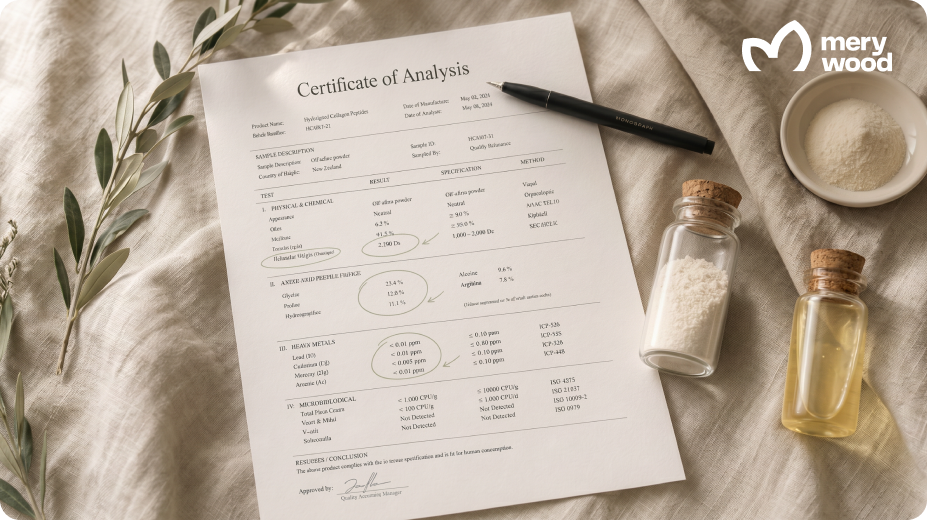
- Molecular weight distribution — gel permeation chromatography. One of the clearest markers of peptide quality.
- Allergens and histamine — additional screens for marine-derived collagen
Only batches that clear every test get release papers. The better manufacturers also stash a sealed retain sample from every batch for three to five years. If a complaint surfaces in 2027, somebody can trace it back to a specific run on a specific day.
Manufacturer’s Advice: When you’re evaluating how is collagen supplement made by a given contract manufacturer, ask for a CoA that includes molecular weight distribution and an amino acid breakdown, not just protein percentage. “92% protein” tells you almost nothing about absorption. A CoA without MW distribution may mean the manufacturer does not routinely test for it, or does not include it in standard release documentation.
Hydrolyzed Collagen vs. Gelatin vs. Native Collagen
The same starting tissue can leave the factory as three different products, depending on where the process stops. Think of a book. Native collagen is the bound, intact volume. Gelatin is the unbound stack of pages. Hydrolyzed collagen is the pages run through a shredder. All three forms have legitimate uses.
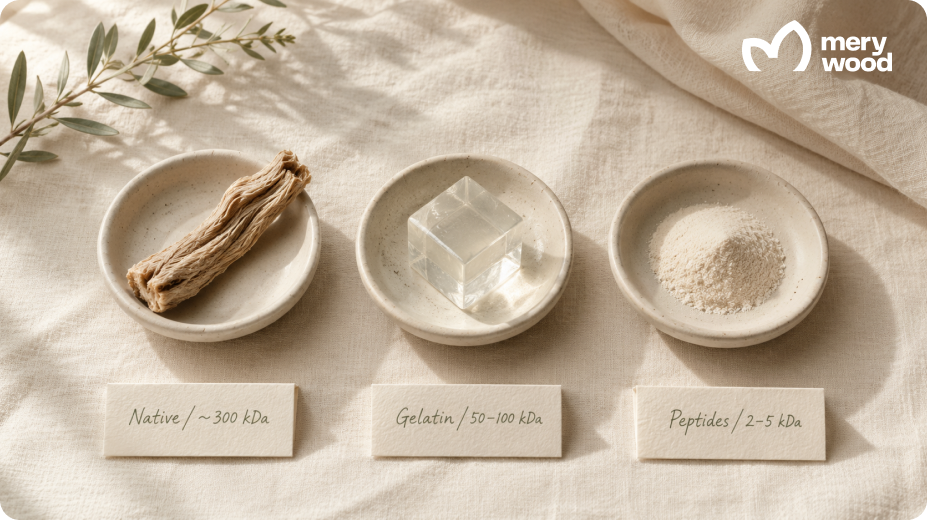
Three forms of collagen
Traditional collagen powder usually means hydrolysate. Most of the collagen supplements on the shelf are nothing more elaborate than spray-dried hydrolysate, packed into a sachet or jar, dressed up with vitamin C and a flavor system at the blender.
What Happens After You Swallow It
You drink the powder. The digestive system breaks most of it further (single amino acids, short di- and tripeptides), and these slip across the intestinal lining into circulation within an hour or two. From there they’re available to whatever tissue wants them. Bone. Cartilage. Skin. The gut lining itself, where glycine and glutamine do quiet work. That’s where the digestive health and gut health claims start, and they’re not nothing.
Two things to say honestly, because the marketing usually won’t.
First: not all collagen peptides reach the bloodstream intact. Research has identified a small fraction of dipeptides (prolyl-hydroxyproline and hydroxyprolyl-glycine, specifically) that survive amino acid degradation and show up in plasma. These fragments may act as signals to fibroblasts in human skin physiology, but the mechanism is still being unpicked in molecular cell biology research. We know more than we did a decade ago. We do not know enough to claim a specific dose triggers a specific result in any given body.
Second: the body has no way to route amino acids exclusively to skin. Once absorbed, glycine, proline, and hydroxyproline join the general amino acid pool. Whether they end up in collagen synthesis depends on local demand and on cofactors — vitamin C above all. The body needs ascorbate for the hydroxylation step that makes the triple helix structure stable. Without adequate vitamin C, collagen synthesis is less efficient.
Insight: Which is why so many collagen supplements bundle in vitamin C. And why a healthy diet, with enough citrus and peppers and the occasional bell-pepper-heavy lunch, matters for what your oral intake actually does.
Quality Markers in a Finished Collagen Powder
Quality varies dramatically across the hundreds of collagen products on European shelves and online stores. A few markers separate serious products from filler:
- Molecular weight distribution. Look for an average and a maximum, both stated. Peptides centered around 2–3 kDa are often preferred for solubility and absorption-focused positioning — a number like “<10 kDa” alone can hide almost anything.
- Source transparency. “Marine collagen from wild-caught Atlantic cod skin” is accountable. “Fish collagen” is not.
- Third-party testing. Independent lab results for heavy metals and microbial purity matter, particularly for fish-derived material from regions with looser fisheries enforcement.
- No proprietary blends hiding fillers. A 10 g serving claiming “11 g of marine collagen and antioxidants” is doing arithmetic that doesn’t add up.
- Sensible additives. Vitamin C, biotin, and hyaluronic acid earn their place — vitamin C, again, because it underwrites the cellular machinery of collagen production. A long string of artificial sweeteners and “proprietary blends” usually doesn’t.
A note on collagen types. Many collagen supplements promise “Type I and III for skin, Type II for joint support and mobility-focused formulas.” Standard bovine hide collagen runs heavy on Types I and III. Bovine cartilage and chicken-sternum products carry Type II. A “multi-collagen” blend is usually a mix of these sources, not some separately engineered ingredient — and what matters more than the marketing label is dose, molecular weight, and whether the formula supports collagen production with the right cofactors.
What Brands Should Decide Before Manufacturing Collagen Products
Seven decisions shape the cost, claims, and consumer experience of any collagen line. Most contract-manufacturing conversations stall when these haven’t been thought through in advance.
- Source. Bovine sets the lowest cost floor and has the deepest research catalogue. Marine reads as premium and works in pescatarian-leaning formulas. Porcine is competitive on price but limited by religious dietary rules. Vegan-positioned blends are amino acid plus cofactor formulas, not literal collagen — and they need to be labeled as such.
- Format. Powder sachets work for travel and trial. Tubs serve loyal daily users. Capsules and tablets matter where flavor or texture would be a problem. Gummies often carry lower collagen doses per serving than powders, but they can perform well in retail because they are easy to take.
- Dose and serving size. Clinical research on skin and joint outcomes mostly used 5–10 g per day. Lower doses can still earn supportive positioning, but it has to be honestly communicated on the label.
- Cofactors. Vitamin C can support EU-compliant claims around normal collagen formation, while biotin and zinc can support approved skin, hair, or nail positioning when used at qualifying levels. Hyaluronic acid can still be used as a formulation ingredient, but any claim language around it needs separate regulatory review. A formulation conversation that doesn’t start with cofactors usually ends with a weaker label.
- Flavor system and solubility. A collagen powder that struggles to dissolve in cold water quickly can create repeat-purchase problems. A neutral, mostly tasteless base is easier to flavor than a fish-forward marine peptide.
- Testing and documentation. Heavy metals, microbiology, molecular weight distribution, amino acid profile — every batch. The Certificate of Analysis is what travels with the product through customs, retailer audits, and future consumer complaints.
- Label and EU compliance. Health claims, nutritional declarations, allergen statements, and country-specific notifications. Getting this wrong delays launches by months and often costs far more than getting it right upfront.
Manufacturing Collagen Supplements with Merywood
Most brand owners don’t blend powder themselves. They partner with a contract manufacturer for supplements that takes them from source choice to EU-ready finished product, handling the seven decision points above without leaving each as a separate negotiation.
Merywood manufactures collagen supplements at HACCP-, GMP-, and ISO-certified facilities in the EU. The work runs from formulation through to packaged finished goods:
- Bovine, marine, or porcine raw materials from EU-audited suppliers, with full traceability documentation through to the final batch.
- Custom cofactor blends with vitamin C, biotin, hyaluronic acid, and other ingredients paired with collagen for skin support or joint mobility positioning.
- Capsules, tablets, powders, sachets, gel formats — chosen to fit your dose, distribution model, and consumer journey. Merywood also develops sports nutrition formulations, so a collagen-plus-protein recovery blend can be added to the same product portfolio.
- Quality control. Heavy metals, microbiology, nutrient breakdown, molecular weight distribution — on every batch, before any product leaves the facility.
- EU product registration support, country-specific notifications, label review against current claims regulations.
Minimum orders begin at 2,500 units for white label supplements (existing formulations from our catalogue) and 5,000 units for private label supplements (your own formula, your own packaging). Whether you’re testing a beauty-from-within line or scaling a focused joint-support product, the work runs end-to-end from one team.
FAQ (Frequently Asked Questions)
How long does it take to manufacture a batch of collagen powder?
A full cycle from raw hide or fish skin to finished powder runs 7 to 21 days, depending on the pretreatment route and how thoroughly the spec demands filtration. Tack on another 1 to 3 weeks for QC release before product actually ships.
How do they make collagen peptides different from regular gelatin?
The first three or four stages are the same — cleaning, pretreatment, hot-water extraction. Gelatin manufacturing stops there. To produce collagen peptides, the manufacturer adds an enzymatic hydrolysis step that breaks the gelatin chains into much smaller fragments, typically in the 2–5 kDa range. That one extra step is the difference between something that gels in your fridge and something that dissolves cold and absorbs in under an hour.
Is hydrolyzed collagen better than collagen protein from food?
Depends what you’re after. Bone broth and skin-on chicken give you collagen protein in a less concentrated, less consistent form. A daily 10-gram serving of collagen peptides hits the same amino acid targets quickly and absorbs faster because the manufacturer has already done the work your stomach would otherwise have to do. Someone eating collagen-rich foods every day gets a smaller marginal benefit from supplementing.
Are marine collagen and bovine collagen interchangeable?
Functionally, more or less. Marine collagen runs a slightly lower average molecular weight in native form and is easier to flavor. Bovine has the deeper research catalog and the lower cost. Amino acid composition differs by single-digit percentages, not by category — and most clinical work on skin elasticity and aging skin used one source or the other with comparable results.
What’s the difference between white label and private label collagen supplements?
White label uses an existing formulation from a manufacturer’s catalogue, packaged with your branding. Faster to market, lower minimum order (typically around 2,500 units), but the formula base is shared with other brands on the same line. Private label means a formula developed specifically for your brand — custom dose, custom ingredients, your own molecular weight target. Higher MOQ (5,000 units and up) and longer lead times, but the product is yours alone.
What does Merywood offer for collagen formulations?
Merywood handles collagen supplements as part of its contract manufacturing service. That includes sourcing bovine, marine, or porcine raw materials from EU-audited suppliers, formulating with cofactors like vitamin C or hyaluronic acid, and packaging into sachets, jars, tubes, or blister packs. Full lab testing (heavy metals, microbiological analysis, nutrient breakdown) runs on every batch before release.
What is Merywood’s minimum order for a custom collagen powder?
White label runs begin at 2,500 units, drawing on existing formulations from our catalogue. Fully private label collagen products — your own formula, your own packaging — start at 5,000 units. Both come with on-demand label printing and EU regulatory support for product registration.
Can Merywood produce vegan collagen alternatives?
Our standard collagen lines use animal-derived sources, where the protein content and the supporting research are strongest. For vegan-positioned products, we formulate amino-acid and vitamin C-based blends designed to support natural collagen production. These are a different category from traditional collagen powder, and accurate labeling matters: they support the body’s own collagen production rather than supplying animal-derived collagen peptides.
Why is vitamin C added to so many collagen supplements?
Vitamin C is a non-negotiable cofactor for collagen synthesis inside the human body. Without it, the enzymes that hydroxylate proline and lysine don’t work, and new collagen fibers don’t form properly. Pairing the two in one product means the dose pulls weight for skin support regardless of what else the day’s diet looks like.
Are collagen peptide supplements safe during pregnancy?
Collagen peptides are widely consumed and are generally treated as a protein ingredient rather than a medicinal ingredient. That said, pregnancy and breastfeeding are not the place for assumptions. Brands typically advise pregnant or breastfeeding consumers to consult a healthcare professional before adding any new supplement.