


How Peptides Are Made: A Field Guide to Modern Peptide Synthesis



How Peptides Are Made: A Field Guide to Modern Peptide Synthesis


A peptide is a small molecule by the standards of biology and a large one by the standards of chemistry. That awkward middle position explains almost everything about how peptides are made.
Not medical advice. This article explains how peptides are made and manufactured for educational and informational purposes only. It does not describe how to use any peptide, supplement, or cosmetic, and it is not medical, clinical, or regulatory advice. Talk to a qualified healthcare professional before using any peptide product, and consult the applicable regulations in your market before manufacturing or selling one.
A typical drug molecule comes together in a handful of reactions. A protein grows inside a cell, folded and finished by machinery that took evolution a few billion years to debug. Peptides sit between those worlds. They are too big to slap together in one flask and too precisely defined to brew in a vat and hope the right sequence shows up. So the people who make them borrowed tools from both sides: the atom-by-atom control of organic chemistry and the scale-up logic of biotechnology.
This guide walks through how peptides work at the level of a single bond, the routes manufacturers actually use, and what separates a clean batch from a crude mess. The focus is production, not patient care. Where the science touches health, treat it as background on manufacturing rather than guidance for use.

What a peptide is, and how peptides work
Start with the building block. An amino acid is a small molecule built around one central carbon. Hanging off that carbon are an amino group, a carboxyl group, a hydrogen, and a side chain. The side chain is the variable part. Swap it, and you move between the twenty standard amino acids that living organisms use, each with its own size, charge, and chemistry.
Link two amino acids and you form a peptide bond: the carboxyl group of one reacts with the amino group of the next, and a single molecule of water leaves the scene. That condensation is the reaction at the heart of all peptide synthesis. Repeat it down a line and you get peptide chains, each with a free amino group at one end, the N terminus, and a free carboxyl group at the other, the C terminus. The chain reads in a direction, the way a sentence does.
How peptides work follows directly from that structure. The order of amino acids, the sequence, decides how the chain folds and what it can recognize. Side chains do the actual chemistry of binding and signaling. Short peptide sequences act as messengers in the body, hormones and neurotransmitters that tell cells what to do. Insulin is the textbook case, a peptide hormone that regulates blood sugar. Stretch a chain past roughly fifty residues and people start calling it a protein, though the line is blurry, nobody guards it strictly, and regulators draw it differently again, sometimes nearer forty.
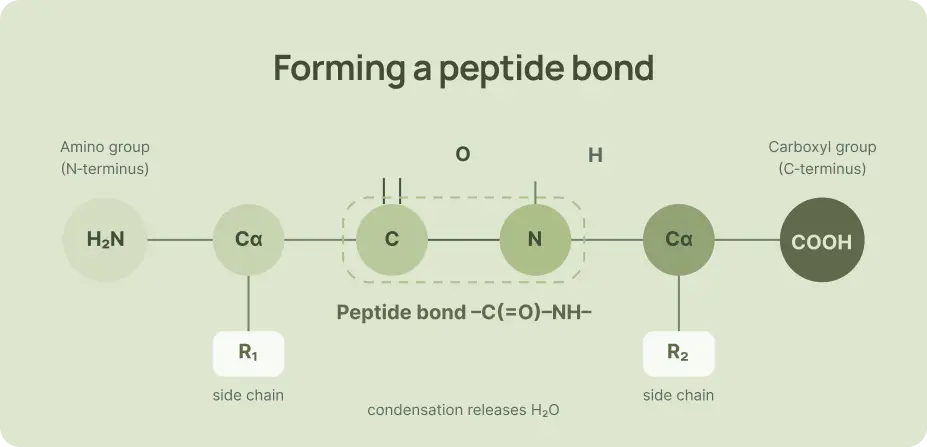
Two amino acids condense into a peptide bond, the –C(=O)–NH– amide link, releasing water. The free amino and carboxyl ends define the N- and C-termini, and the side chains stay free to do the chemistry.
 Key point: biology builds peptide chains from the N terminus toward the C terminus. Most chemical synthesis runs the opposite way, C to N. That single reversal shapes how the entire process is set up.
The main routes to making peptides
Chemical synthesis assembles a defined sequence one amino acid at a time. It rules the territory of short to medium peptides, roughly up to fifty residues, and it is the route behind custom peptide synthesis, research peptides, and the signaling peptides used in cosmetic formulations. The chemist decides every residue, so chemical synthesis also opens the door to unnatural amino acids that no cell would ever insert.
Recombinant production in living organisms
For longer peptides and full proteins, building atom by atom gets expensive and error-prone, so manufacturers hand the job to biology. Engineer a gene into bacteria or yeast and the living organisms churn out the sequence for you, after which it is extracted and purified. Insulin tells the story of the shift. Manufacturers once obtained it from animal pancreas tissue; today it is produced in recombinant microbes and purified to a defined product. The cell does the hard sequence work; the factory does the cleanup.
Hydrolysis and extraction run in reverse. Rather than assemble a sequence, you take a large natural protein and chop it into shorter peptide chains. Collagen peptides, the kind that fill supplement tubs, come from enzymatically cutting collagen into smaller, more soluble fragments. The distinction matters for formulators: a collagen peptide is a defined ingredient produced by breaking something down, not a designed sequence produced by building one up.
Three production routes at a glance
Solid phase peptide synthesis, the workhorse
When people ask how peptides are manufactured at the lab bench, the honest answer is usually solid phase peptide synthesis. Bruce Merrifield introduced the method in the early 1960s and collected a Nobel Prize for it in 1984, and the core trick still carries most of the field.
The trick is the solid support. Instead of growing the chain free in solution and purifying after every coupling step, you anchor it to an insoluble resin bead. Now the growing chain stays put while everything else gets rinsed past it. Excess reagents and by-products are easily washed away, which turns a brutal series of isolations into a rhythm of pour, react, drain, repeat. Think of it as building a necklace where the clasp is bolted to the workbench, so you can hose down the whole thing between beads without losing your work.
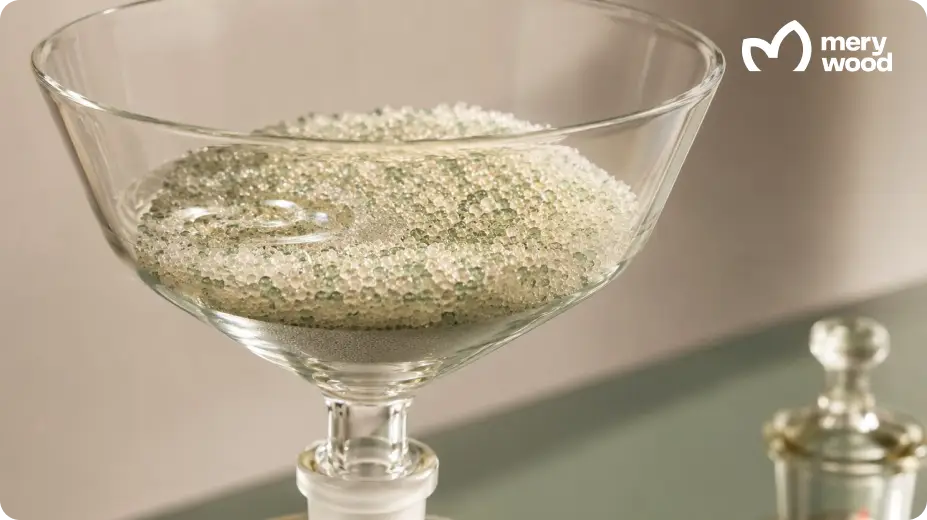
Solid phase methods build the chain from the C terminus toward the N terminus. The first amino acid attaches through its carboxyl group to the solid support, and from there the cycle runs. Each round adds one residue through three moves:
- Deprotection. Strip the temporary protecting group off the exposed amino group so it can react.
- Coupling. Activate the carboxyl group of the next amino acid with coupling reagents and let peptide bond formation join it to the chain.
- Wash. Flush out unreacted reagents, excess reagents, and by-products while the chain holds fast to the resin.
Run that loop as many times as the sequence is long. A monitor watching UV absorbance can track how cleanly each deprotection went, which gives the operator a read on coupling efficiency before problems pile up.
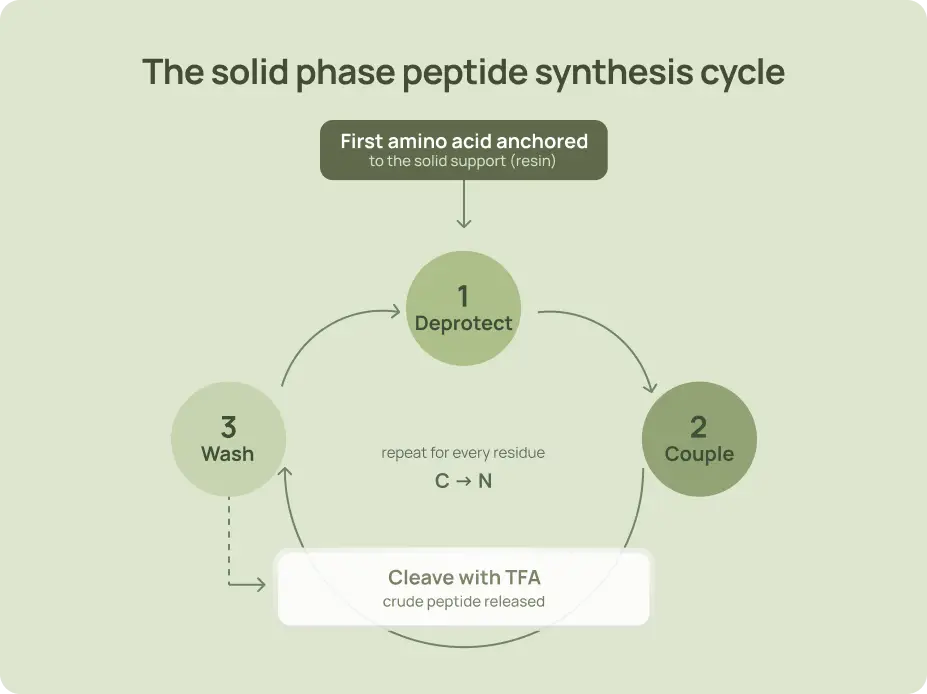
One residue per loop. The chain stays on the support through every deprotection, coupling, and wash, then comes off in a single cleavage step.

Insight: Coupling efficiency is unforgiving because the steps multiply. A coupling that works 99 percent of the time sounds excellent until you string thirty of them together: the chain comes off with only about three quarters of it intact. That arithmetic is why difficult sequences need optimized reaction conditions, not just good intentions.
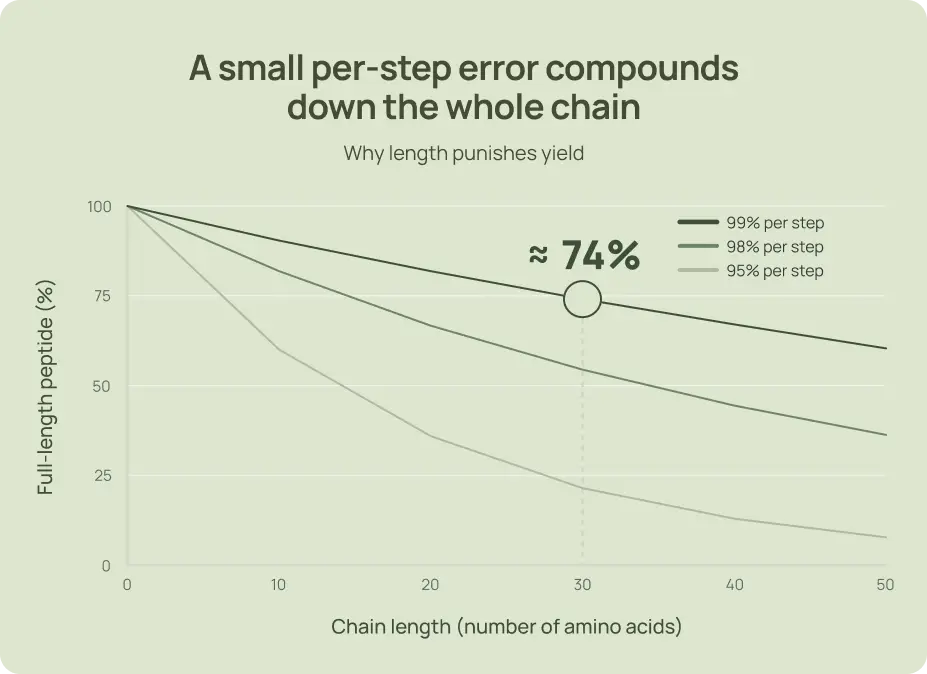
Coupling errors compound. Even at 99% per step, a 30-residue chain finishes only about three-quarters intact; drop to 95% and the full-length product collapses toward a smear.
Protecting groups, the unsung guardians
Amino acids are covered in reactive groups, and that is the whole problem. Leave them exposed and a coupling step would fire in every direction at once, stitching side chains to backbones and producing a tar of unwanted reactions. Protecting groups solve this by masking the reactive groups you want to keep quiet, so peptide bond formation happens only where you intend.
The work splits into two tiers. A temporary protecting group sits on the N-terminal amino group and comes off at the start of every cycle, exposing the chain for the next coupling. Permanent side chain protecting groups stay clamped on throughout the whole synthesis and only release at the very end. Manage both tiers and you steer the reaction down a single clean path.

Fmoc and Boc chemistry
Two protecting group strategies define modern peptide chemistry. Fmoc comes off under mild base, usually piperidine, and has become the default for most peptide synthesis because it skips the harshest reagents. Boc comes off under acid, and classical Boc SPPS historically relied on hydrogen fluoride for the final cleavage, which kept it in specialist hands. The older benzyloxy carbonyl group, often written Cbz or Z, still appears in solution work and in textbooks as the ancestor of both. Picking between Fmoc and Boc sets the tone for every other reagent on the bench.
Fmoc and Boc compared
Cleavage: getting the peptide off the support
Once the last residue is in place, the peptide has to come home. In Fmoc chemistry, trifluoroacetic acid does double duty: it severs the bond to the solid support and strips the permanent side chain protecting groups in one pass. Scavengers ride along to mop up the reactive fragments that cleavage throws off, sparing the peptide from late side reactions. What drops out is often a TFA salt of the crude product.
Crude is the operative word. The vial now holds the target sequence mixed with deletion sequences where a coupling stumbled, plus assorted by products and reagent residue. Nothing about this material is a final product yet. Purification is a separate discipline, and it is where many batches are won or lost.
Solution phase synthesis: when and why
Solution phase synthesis predates the solid support era and still earns its place. Here every intermediate floats free and gets isolated and purified before the next coupling. That is punishing for long chains, but for shorter peptide chains made at large scale it can beat SPPS on cost, since you are not paying for resin or running a column on tonnage quantities.
The two approaches also team up. A common move is to build fragments by solid phase synthesis, then stitch those fragments together in solution through fragment condensation. Hybrid routes like this reach longer peptides that pure stepwise assembly handles poorly, and they give process chemists a lever to pull when a single straight-through synthesis keeps failing.
Purification and quality control
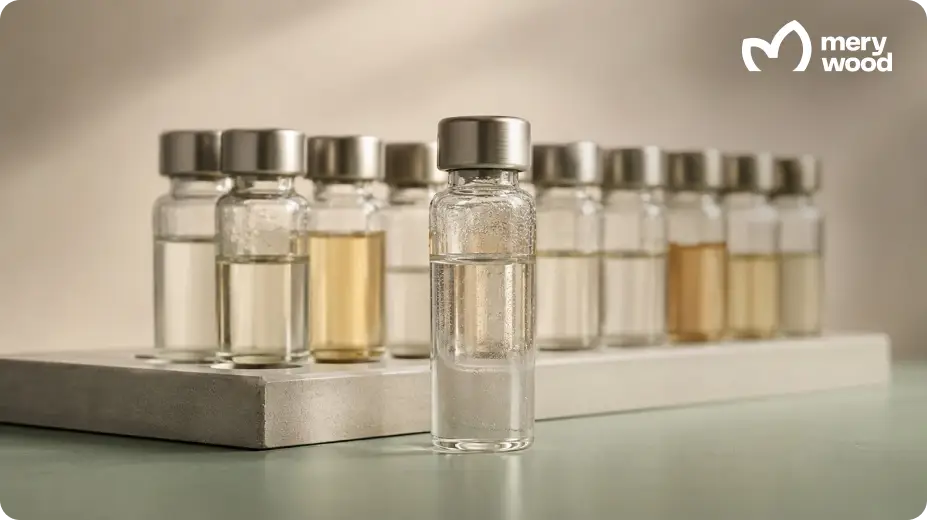
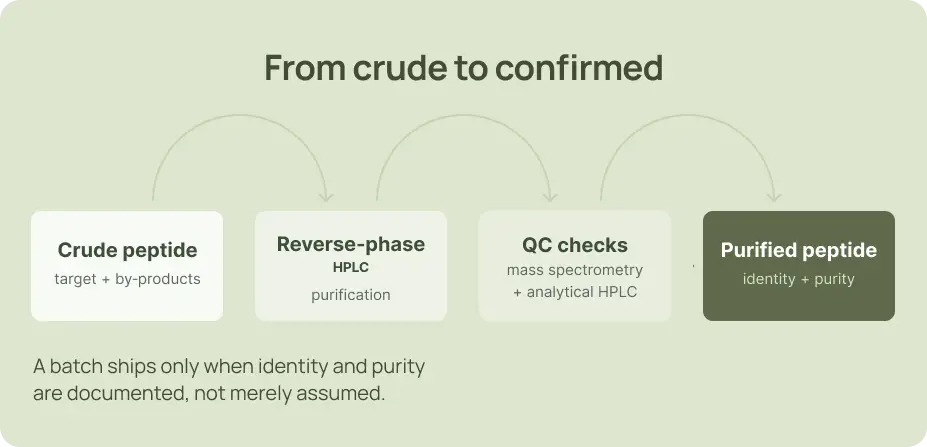
Purification and quality control decide the outcome: identity by mass spectrometry, purity by HPLC, before anything ships.
Reverse-phase HPLC is the standard way to purify peptides. It sorts molecules by how strongly they cling to a column, which separates the target from closely related impurities that differ by a single residue. A detector reading UV absorbance flags each peak as it elutes, and on a preparative scale the operator collects only the fraction that matters. Peptide purification is rarely one and done; tricky mixtures go around more than once.
Then comes proof. Mass spectrometry confirms that the measured molecular mass matches the expected peptide mass, which catches gross errors but does not, on its own, prove the full sequence. Analytical HPLC reports purity as a number. For fuller identity, a lab adds MS/MS sequencing, amino acid analysis, or other orthogonal methods. Quality control is the gate: a peptide that cannot show its identity and purity on paper has no business leaving the building, whatever the synthesis looked like.
Why some peptides fight back
Not every sequence cooperates. Aggregation prone sequences fold against themselves partway through the build, burying the reactive end so the next coupling stalls. Long peptides accumulate small failures until the crude looks like a smear. A few residues racemize or invite side reactions that scramble the result. Two peptides of the same length can differ wildly in how hard they are to make.
Process chemists fight back with sharper tools: stronger coupling reagents, tuned reaction conditions, and capping steps that cap any unreacted chain so it cannot quietly become a deletion sequence later. Sometimes the fix is to redesign the route entirely. The blunt truth is that a clean ten-residue peptide and a stubborn forty-residue one are not in the same league, and anyone quoting a flat price per residue has not met the hard ones.
From a synthesized peptide to a finished product
Synthesizing the molecule is one stage. Turning it into something a brand can sell is another discipline, and the gap between them swallows a lot of first-time founders. A purified peptide still needs a formulation, a stable delivery format, packaging that protects it, and a paper trail that satisfies EU rules before it becomes a market-ready SKU. Peptide stability in particular tends to dictate format and storage more than newcomers expect.
Not every peptide belongs in a supplement or a cosmetic, either. Collagen peptides and selected cosmetic peptides sit in a very different regulatory lane from therapeutic or hormone-like peptides, some of which are drugs and some of which are not legal to sell at all. Before formulation starts, the ingredient’s legal status, intended use, route, claims, and target market all need checking. That homework is cheaper to do first than to unwind after a batch exists.
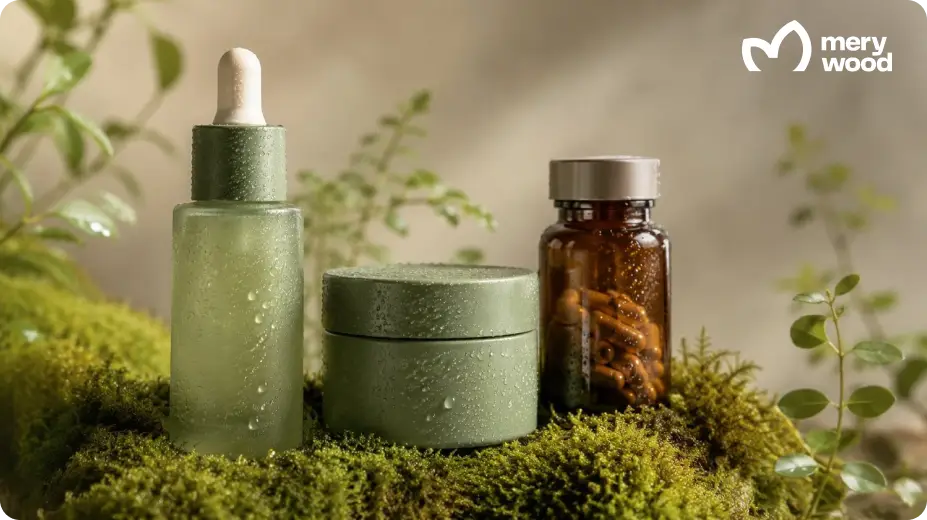
That finished-product end is where a contract manufacturer fits. Merywood develops and produces private label and white label supplements and cosmetics across the EU, running formulation and R&D in house, sourcing raw materials, and supporting EU regulatory work, including product notification or registration where required, ingredient documentation, and HACCP documentation, so a brand can launch under its own name. Eligible peptide-based formulations sit inside that supplement and cosmetic remit, on the productization side rather than the raw-synthesis side.
Manufacturer’s advice: whatever route makes your peptide, demand the receipts. Ask for a certificate of analysis showing identity by mass spectrometry and purity by HPLC before a single ingredient enters a formulation. Then plan around peptide stability early, because the format and packaging that keep a peptide intact on the shelf are easier to design in than to retrofit.
Ready to develop your own peptide line? Explore our capabilities or contact our team to get started.

Frequently asked questions
How are peptides made, in short?
Peptides are made by joining amino acids through peptide bonds in a set order. Most defined sequences are built by chemical synthesis, usually solid phase peptide synthesis, where the chain grows one amino acid at a time on a resin, then gets cleaved, purified, and checked. Longer peptides and proteins are often produced in living organisms instead, and ingredients like collagen peptides come from breaking a larger protein down.
What is the difference between solid phase and solution phase synthesis?
Solid phase peptide synthesis anchors the growing chain to a resin so excess reagents can be washed away between steps, which suits most short to medium custom peptides. Solution phase synthesis keeps everything free in solution and isolates each intermediate, which is slower for long chains but can win on cost for shorter peptide chains produced at large scale.
How are peptides purified after synthesis?
The standard method is reverse-phase HPLC, which separates the target from closely related impurities and uses UV absorbance to track each peak. Operators collect the pure fraction, then confirm the result with mass spectrometry for identity and analytical HPLC for purity. A peptide is not considered finished until that quality control is documented.
Are peptides made naturally in the body?
Yes. Cells assemble peptides and proteins on ribosomes, reading a genetic template and linking amino acids from the N terminus to the C terminus. Lab synthesis mimics the chemistry of the peptide bond but typically runs the chain in the opposite direction and uses protecting groups that biology has no need for.
How are collagen peptides in supplements made?
Collagen peptides are produced by hydrolysis rather than by building a sequence. Enzymes cut collagen into shorter, more soluble fragments, which is why a collagen peptide powder is a mixture of fragments instead of one designed sequence. That is a different process from the solid phase methods used for defined cosmetic or research peptides.
Why are some peptides so much more expensive than others?
Cost tracks difficulty. Longer peptides, aggregation prone sequences, and chains that need special amino acids drive down coupling efficiency and demand harder purification, so the price climbs with the number of steps and the trouble at each one. A short, well-behaved peptide and a long, stubborn one can differ by orders of magnitude.
Can chemical synthesis make peptides that do not occur in nature?
Yes, and that is one of its advantages. Because the chemist chooses every residue, custom peptide synthesis can incorporate unnatural amino acids and modifications that no living organism would produce, which is heavily used in medicinal chemistry and peptide research.
Does Merywood manufacture peptide-based supplements and cosmetics?
Merywood is a private label and white label contract manufacturer of supplements and cosmetics in the EU, producing finished products under HACCP standards. Its model covers formulation, R&D, ingredient sourcing, and regulatory support. Eligible peptide-containing supplement and cosmetic formulations can fall within its custom development and white label capabilities, provided the ingredient’s legal status, intended use, claims, and target market are checked first. This sits on the productization side rather than raw peptide synthesis.
What is the minimum order to launch a product with Merywood?
White label orders start from 2,500 units and private label orders from 5,000 units. Merywood runs a full-cycle partnership from consultation and formulation through label printing, EU regulatory support, production, and logistics, and it works with brands across 27 countries.
How does Merywood ensure product quality and EU compliance?
Every product is made under strict HACCP standards in the EU, with an in-house team handling formulation and testing. Merywood supports ingredient documentation, EU compliance paperwork, and product notification or registration where required. For cosmetics, that can include CPNP-related documentation; for supplements, the requirements depend on the target EU market.
Sources
- The Nobel Prize in Chemistry 1984 (R. Bruce Merrifield). Origin of solid phase peptide synthesis. org
- Behrendt, White & Offer (2016), Advances in Fmoc solid-phase peptide synthesis, Journal of Peptide Science. Fmoc SPPS as the current method of choice. ncbi.nlm.nih.gov
- HPLC analysis and purification of peptides (Methods in Molecular Biology). Reverse-phase HPLC for peptide purification and analysis. ncbi.nlm.nih.gov
- Progress in Research on Animal Collagen Peptides: Preparation, Bioactivity, and Application. Collagen peptides produced by hydrolysis. nlm.nih.gov
- S. FDA, ANDAs for Certain Highly Purified Synthetic Peptide Drug Products. Uses 40 or fewer amino acids as the peptide threshold in this drug-product guidance. fda.gov
- European Commission, Cosmetic Product Notification Portal (CPNP), Regulation (EC) No 1223/2009. EU cosmetics notification. single-market-economy.ec.europa.eu
- European Commission, Food supplements, Directive 2002/46/EC. EU food supplement framework. ec.europa.eu
- Private and white label manufacturing, minimum order quantities, and EU regulatory support. merywood.com