



Vitamins for Bones and Joints: What Works, What’s Hype, and What Belongs in a Formula



Vitamins for Bones and Joints: What Works, What’s Hype, and What Belongs in a Formula


Search “vitamins for bones and joints” and you get a list. Calcium, vitamin D, maybe collagen, probably glucosamine, and a shelf of products promising to handle all of it in one capsule. The list isn’t wrong. It’s flattened. Bones and joints are two different tissues doing two different jobs, and they don’t answer to the same nutrients in the same way.
That distinction is where most of the confusion starts, and it’s where this guide begins. We’ll separate the two systems, grade the evidence the way a formulator actually reads it, and then look at the part most articles skip: how a nutrient on a research paper turns into a product someone wants to take twice a day for a year.
Not medical advice
This article is general information, written for readers researching the topic and for brands developing supplement products. It does not diagnose or treat any condition and does not replace advice from a qualified healthcare professional. Nutrient needs vary from person to person. Some interact with medication, vitamin K with blood thinners being the classic example. If you have a health condition or take any medication, talk to your doctor before starting a supplement.
Bones and joints are not the same problem
Picture the skeleton as a building. Bone is the structure: a living mineral scaffold that the body constantly tears down and rebuilds, roughly a full turnover every decade. Its strength comes from calcium and phosphate crystals packed onto a framework of collagen protein. Feed that process the right raw materials and the scaffold holds. Starve it, and the body pulls minerals back out of the skeleton to use elsewhere.

A joint is the hinge where two bones meet, and it’s built for a different job: cushioning and glide. The working surface is cartilage, a firm, slippery tissue with no blood supply of its own, made mostly of collagen and water held in a mesh of proteoglycans. Cartilage doesn’t repair itself the way bone does. Once it wears, it tends to stay worn.
So the nutrients that matter split along tissue lines. Bone care leans on minerals and the vitamins that manage them. Joint care leans on collagen-related building blocks, connective-tissue support, and ingredients studied for inflammatory pathways. A few nutrients, vitamin C and vitamin D chief among them, show up in both columns, which is exactly why they anchor most sensible formulas.
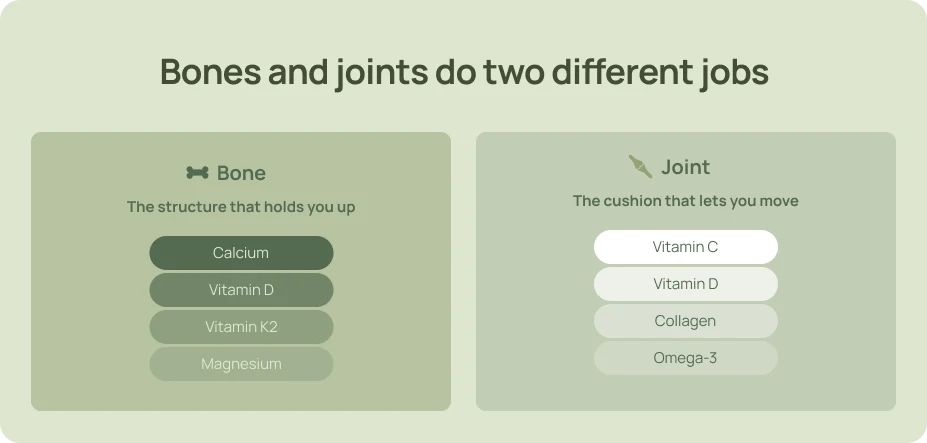
Figure 1 — Two tissues, two jobs. Bone is a mineral scaffold that mineral crystals load onto a collagen frame. A joint is a cartilage cushion built for glide. Vitamin C and vitamin D serve both, which is why they anchor most formulas.
Vitamins for strong bones
Bone is the better-understood half of the story, and the evidence here is genuinely strong. Four nutrients do the heavy lifting, and a handful more play support.
Calcium is the raw material. About 99 percent of the body’s calcium is locked in the skeleton and teeth, and when blood levels dip, the body withdraws from that reserve. Diet covers it for most people: dairy, fortified plant milks, tofu set with calcium, leafy greens, and canned fish eaten with the soft bones. Supplements earn their place when intake runs low, not as a top-up for people who already eat well.
Vitamin D is the key that unlocks the door. Without enough of it, the gut absorbs only a fraction of the calcium you swallow, and the rest passes straight through. Skin makes vitamin D from sunlight, but latitude, winter, sunscreen, office jobs and darker skin all cut production, which is why deficiency is common across northern Europe. Many North American guidelines put adult needs around 600 to 800 IU (15 to 20 mcg) a day, with more for older adults, while UK guidance uses 10 mcg (400 IU) as the general adult baseline and higher amounts for people at risk of osteoporosis. For brands, the vitamin D story is the reason it sits in almost every bone formula, and Merywood produces it as a standalone line too; see the vitamin D manufacturing page for formats and dosing.
Vitamin K2 directs traffic. It activates osteocalcin, a protein that grabs calcium from the blood and binds it into bone, and it activates a second protein that helps keep calcium out of arteries where it doesn’t belong. The long-chain form, MK-7, stays active in the body far longer than the K1 in leafy greens and suits once-a-day dosing. Here’s where honesty matters: K2 reliably improves the biomarkers, meaning it measurably lowers undercarboxylated osteocalcin and shifts the protein into its active, calcium-binding (carboxylated) form, but trials on the outcomes that count, bone density and fractures, have been genuinely mixed. One three-year study using 180 mcg of MK-7 (Knapen 2013) helped slow age-related bone loss; another using 375 mcg over the same period in women with osteopenia (Rønn 2021) raised osteocalcin carboxylation yet found no effect on density or microarchitecture. K2 belongs in a serious bone formula, but any brand claiming it prevents fractures on its own is running ahead of the data. Merywood formulates it across delivery formats on the vitamin K manufacturing page.
Magnesium is the quiet enabler. Roughly half the body’s magnesium sits in bone, and the mineral is a cofactor for the enzymes that build the skeleton and for the step that converts vitamin D into its active form. Deficiency is widespread and worth correcting, though magnesium works as part of the team rather than as a standalone bone builder.
Then the supporting cast. Vitamin C builds the collagen scaffold that mineral crystals attach to, which is why it appears in both the bone and joint columns; scurvy is the grim demonstration of what its absence does to connective tissue. The B vitamins B6, B9 and B12 keep homocysteine in check, and high homocysteine tracks with fracture risk in older people, though correcting a deficiency is sensible while megadosing hasn’t reliably cut fractures. Zinc, copper, manganese and boron act as cofactors for collagen cross-linking and matrix formation: real contributors, modest effect, best thought of as the rhythm section.
Bone nutrients at a glance
Already picturing this as a product?
Merywood turns a nutrient list like this into a compliant, finished formula.

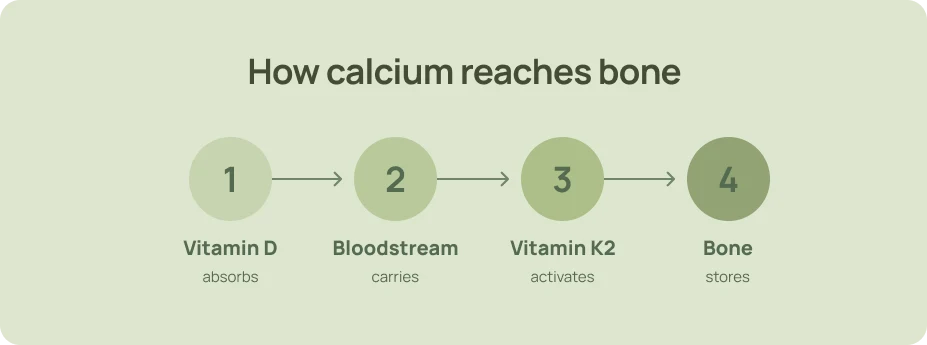
Figure 2 — How calcium reaches bone. Two vitamins do distinct jobs: D governs how much calcium gets in, K2 governs where it ends up. This is why they’re usually paired in a formula.
Joint care vitamins, and the ingredients that aren’t vitamins
The joint aisle is messier, for one reason worth stating plainly: most of what’s sold for joints isn’t a vitamin. Collagen, omega-3, glucosamine and chondroitin dominate the category, and none of them is a vitamin. People search “joint vitamins” and mean “things that help my joints,” so any useful answer has to cover the whole shelf while being clear about what each thing actually is.
Start with the genuine vitamins. Vitamin C is the most indispensable of the true vitamins for joints, because cartilage is mostly collagen and the body cannot make collagen without it. That’s not a marketing line, it’s biochemistry; vitamin C is a required cofactor for the enzymes that assemble collagen. Vitamin D earns its spot differently. Low vitamin D tracks with more joint pain and worse physical function, and correcting a deficiency helps some people, though it works by fixing a shortfall rather than acting as a painkiller. Both are reasons Merywood puts vitamin C at the center of joint formulas; the vitamin C manufacturing page covers the forms and doses that survive tableting.
Now the non-vitamins, which is where the demand and the debate both concentrate.
Collagen peptides supply the amino acids cartilage is built from, and some research suggests they nudge cartilage cells to produce more matrix. The clinical picture is cautiously positive: across several randomized trials and a meta-analysis, daily collagen peptides eased pain and improved function in people with mild-to-moderate knee osteoarthritis, usually over 8 to 24 weeks, at doses commonly in the 5 to 10 gram range. Two honest caveats. The quality of that evidence is often rated low, and collagen helps early-to-moderate wear, not a bone-on-bone joint that’s past the point nutrition can reach.
Omega-3 fatty acids are studied mainly for inflammatory pathways rather than cartilage structure, with the clearest rationale in inflammatory joint conditions rather than ordinary wear-and-tear osteoarthritis. As a well-studied foundation ingredient it is easy to justify in a joint stack. Merywood runs it as a dedicated line; details are on the omega-3 manufacturing page.
Glucosamine and chondroitin are the most contested products in the category, and any guide that pretends otherwise isn’t being straight. They’re natural components of cartilage, taken in the hope of protecting it. The evidence is a patchwork. The American College of Rheumatology strongly recommends against both glucosamine and chondroitin for knee and hip osteoarthritis, with one narrow exception: chondroitin is conditionally recommended for hand OA on the strength of a single well-conducted trial. European guidance from ESCEO takes a warmer view of specific pharmaceutical-grade forms, glucosamine sulfate and chondroitin sulfate. Across the trials, chondroitin tends to show a more consistent effect on pain and function than glucosamine does. The practical read for a brand: grade and form matter more than the ingredient name on the label, and expectations should be set at “may help some people,” not “guaranteed relief.” Contested evidence is not the same as a dead ingredient. It usually means the effect rides on form, dose, the population studied, whether a real deficiency was present, and which endpoint the trial measured, which is exactly why a serious formula specifies all of those rather than listing a bare ingredient name.

The joint shelf at a glance
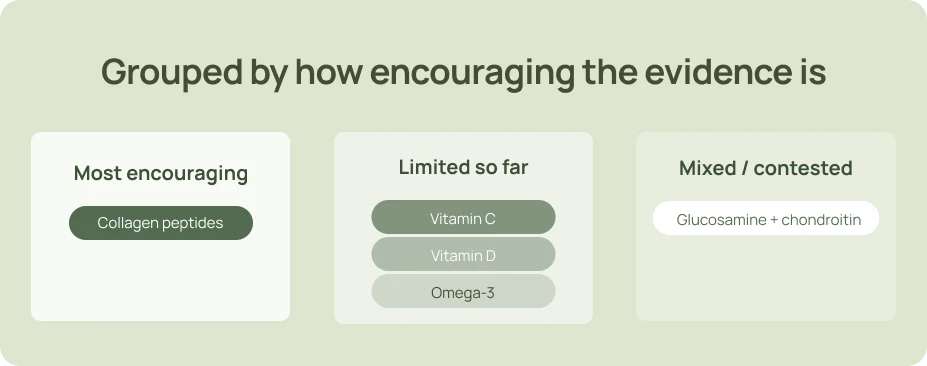
Figure 3 — Grouped by how encouraging the evidence is. This ranks clinical-trial support for easing joint symptoms, a different question from the biochemistry above. Collagen peptides have the most encouraging trial data; vitamin C, vitamin D and omega-3 have a solid rationale but thinner joint-symptom evidence; glucosamine and chondroitin stay contested.
What supplements can and can’t do
Set expectations correctly and everyone wins, the customer most of all. Here’s the honest frame.

For bones, nutrients prevent the losses that deficiency causes and give the rebuilding process what it needs. They are not drugs. If someone already has osteoporosis, vitamins support treatment but don’t replace it, and the visible payoff is slow, because bone remodels over months and years and gets measured on a DXA scan, not felt week to week.
For joints, the ceiling is symptom relief and slower decline in early-to-moderate cases. No pill regrows cartilage that’s gone. What a good joint supplement can realistically do is take the edge off pain, support the tissue that remains, and buy comfort and mobility, which for most people is the point.
And the diet question, which the Royal Osteoporosis Society answers bluntly and correctly: a healthy, balanced diet already delivers most of what bones need, and many people don’t require supplements at all. The honest exceptions are real, though. Vitamin D is hard to get from food and depends on sun most of us don’t see enough of. Absorption drops with age. Restricted diets leave gaps. Supplements exist to fill those gaps, not to replace a decent plate of food.
Vitamins for bones and joints for adults
“For adults” isn’t a throwaway qualifier in the search box. It points at a real shift. The people typing it are usually past 40 and noticing that maintenance now takes effort it didn’t before, and biology backs the instinct.
Several things change with age at once. Skin makes less vitamin D from the same sunlight. The gut absorbs calcium less efficiently. Stomach-acid changes and common medications cut B12 absorption. And after menopause, the drop in estrogen speeds up bone breakdown, which is why women’s fracture risk climbs sharply in the years that follow. On the joint side, decades of use simply add up, and cartilage that never had a repair crew starts to show it.

The practical takeaway is targeting, not megadosing. For an adult building a routine, the defensible core is vitamin D (tested if there’s any doubt about levels), enough calcium from diet first and a supplement only if it falls short, vitamin K2 to direct that calcium, and magnesium to support the machinery. Anyone focused on joints can reasonably add vitamin C, collagen, and omega-3, and give any joint product a fair 8 to 12 week trial before judging it. None of that is a prescription, and it’s worth repeating that individual needs and medications change the picture.
From nutrient list to finished product
This is the part that separates a good article from a good product, and it’s where a contract manufacturer earns its keep. Knowing that vitamin K2 belongs in a bone formula is the easy 10 percent. The other 90 percent is turning that knowledge into something legal, stable, effective and pleasant enough to buy again.
Form is as important as the ingredient
Vitamin D3 outperforms D2 at raising blood levels. MK-7 beats MK-4 for once-daily dosing because it lasts longer in the body. Magnesium glycinate is gentler on the stomach than cheaper oxide. Low-molecular-weight, hydrolyzed collagen absorbs better than raw gelatin. Two labels can list the same nutrient and behave nothing alike, and the difference is entirely in the sourcing.
Dose has to match the claim and the evidence
“Contains vitamin K2” is meaningless if the amount sits below what trials actually used. Underdosing to hit a price point is the quiet killer of both efficacy and repeat purchase, because the customer feels nothing and doesn’t reorder. A credible formula doses to the research, then prices around that, not the other way round.
The label has to obey the rules
In the EU, only authorized health claims are allowed, and they’re carefully worded. A product may say that “vitamin D contributes to the maintenance of normal bones,” that “vitamin C contributes to normal collagen formation for the normal function of cartilage,” or that “calcium is needed for the maintenance of normal bones.” It may not say the product treats arthritis or prevents fractures. One trap catches collagen brands in particular: collagen itself carries no authorized EU health claim. For collagen formulas, the compliant route is usually not to claim a benefit for collagen directly, but to include a claim-eligible nutrient such as vitamin C and use its authorized claim on normal collagen formation, where the finished product meets the conditions of use. Getting claims right keeps the product on the market and the marketing honest, and it’s the fastest place for an inexperienced brand to get into trouble.
Format shapes who buys and whether they stick with it
Capsules suit purists and travel well. Gummies win on compliance for people who won’t swallow pills, though they cap how much active you can load. Effervescent tablets and powders handle the bulky actives, and calcium and collagen are bulky, that never fit into one small capsule. Sachets and liquid drops open up on-the-go and pediatric uses. The right format is a marketing decision as much as a technical one.
Then the details that sink amateurs
Shelf stability, allergen handling for fish-derived omega-3 and marine or bovine collagen, vegan sourcing where the audience expects it (lichen-derived D3, algal omega-3), and the label cautions that have to be there, such as the note on vitamin K and blood thinners. This is the work Merywood does end to end, from formulation to EU compliance to finished, shipped product. The full scope lives on the contract manufacturing page.
Thinking about a bone or joint supplement for your brand?
Merywood develops and manufactures supplements in the EU under HACCP standards, from a custom formula or from our catalogue, with regulatory support built in. Tell us the product you have in mind and we’ll take it from formulation to shelf.

Frequently asked questions
What vitamins are best for strong bones and joints?
For bones, the core four are vitamin D, calcium, vitamin K2 and magnesium, with vitamin C building the collagen underneath. For joints, vitamin C leads among the true vitamins, supported by vitamin D, and joined by the non-vitamin players most people expect on that shelf: collagen peptides and omega-3. A well-rounded routine draws from both lists rather than piling on a single nutrient.
Can vitamins reverse joint damage or rebuild cartilage?
No. Cartilage has no blood supply and doesn’t regenerate the way bone does, so no supplement regrows a worn joint. What the right nutrients can realistically do is support the tissue that remains and ease pain and stiffness in early-to-moderate cases. For advanced joint damage, supplements are a comfort measure alongside medical care, not a repair.
What’s the difference between vitamin K1 and K2 for bones?
K1, from leafy greens, mostly serves blood clotting and is absorbed relatively poorly. K2, from fermented foods, is the form your bones use: it activates osteocalcin, the protein that binds calcium into the skeleton. The long-chain K2 form MK-7 stays active longer and suits once-daily dosing, which is why formulators prefer it, even though its effect on fractures in trials has been inconsistent.
How much vitamin D do adults need for bone health?
Many North American guidelines land around 600 to 800 IU (15 to 20 mcg) a day for adults, with more often advised for older people, while UK guidance uses 10 mcg (400 IU) as the general adult baseline and 20 mcg (800 IU) for those at risk of osteoporosis. Because vitamin D depends heavily on sun exposure, levels vary a lot by season and lifestyle, and a blood test is the only way to know where you actually stand. This is general information, not a dosing recommendation; check with your doctor before supplementing, especially at higher doses.
Are joint supplements like glucosamine and collagen actually worth taking?
Collagen has the more encouraging evidence: several trials show reduced pain and better function in mild-to-moderate knee osteoarthritis over a couple of months. Glucosamine and chondroitin are more contested, with guidelines split and results depending heavily on the grade and form used. If you try either, give it 8 to 12 weeks and judge honestly, since neither is a guaranteed fix.
Can I get enough of these nutrients from food instead of supplements?
Often, yes. A balanced diet covers most bone and joint nutrients, and many people don’t need supplements at all. The honest exceptions are vitamin D, which is hard to get from food and depends on sunlight, and situations where absorption or diet fall short, such as older age or restrictive eating. Supplements are best used to fill identified gaps, not to replace good food.
How long before bone or joint supplements start working?
Bone changes slowly. It remodels over months and years, and progress shows up on a bone-density scan rather than in how you feel. Joint symptom relief from collagen or similar products typically takes 8 to 24 weeks of consistent use. Either way, patience and regular dosing matter more than any single “fast-acting” claim on a label.
Can Merywood manufacture a custom bone and joint supplement under my own brand?
Yes. Merywood produces supplements under your brand either as private label from your own custom formula (minimum order 5,000 units) or as white label from an existing catalogue formulation (minimum order 2,500 units). Everything is made in the EU under HACCP standards, with a full-cycle service that runs from formulation and ingredient sourcing through regulatory support to finished, shipped product.
What formats can Merywood produce a bone or joint formula in?
The bulky actives common in this category, calcium and collagen especially, shape the choice. Merywood produces capsules, tablets, blister packs, powders and doypacks, sachets, effervescent tablets, liquid drops and gummies. Capsules and tablets suit compact daily doses, powders and effervescents handle higher-gram actives, and gummies or drops help with compliance and on-the-go use.
Which certifications and markets does Merywood cover?
Production runs in the EU under HACCP standards, with regulatory support that includes EU product registration and ingredient documentation, so a finished product launches compliant rather than scrambling for paperwork later. Merywood is trusted by brands in 27 countries and has developed more than 200 formulations across supplements and cosmetics. Reach the team through the contact form on the site.
Sources
- National Institutes of Health, Office of Dietary Supplements. Calcium: Fact Sheet for Consumers. ods.od.nih.gov/factsheets/Calcium-Consumer
- National Institutes of Health, Office of Dietary Supplements. Vitamin D: Fact Sheet for Consumers. ods.od.nih.gov/factsheets/VitaminD-Consumer
- Royal Osteoporosis Society. Vitamin D for bones. theros.org.uk
- Royal Osteoporosis Society. Vitamins, minerals and nutrients for bones. theros.org.uk
- Knapen MH, Drummen NE, Smit E, Vermeer C, Theuwissen E. Three-year low-dose menaquinone-7 supplementation helps decrease bone loss in healthy postmenopausal women. Osteoporos Int. 2013;24(9):2499–2507. doi:10.1007/s00198-013-2325-6
- Rønn SH, Harsløf T, Oei L, Pedersen SB, Langdahl BL. The effect of vitamin MK-7 on bone mineral density and microarchitecture in postmenopausal women with osteopenia, a 3-year randomized, placebo-controlled clinical trial. Osteoporos Int. 2021;32(1):185–191. doi:10.1007/s00198-020-05638-z
- Kolasinski SL, Neogi T, Hochberg MC, et al. 2019 American College of Rheumatology/Arthritis Foundation Guideline for the Management of Osteoarthritis of the Hand, Hip, and Knee. Arthritis Rheumatol. 2020;72(2):220–233. doi:10.1002/art.41142
- Bruyère O, Honvo G, Veronese N, et al. An updated algorithm recommendation for the management of knee osteoarthritis from ESCEO. Semin Arthritis Rheum. 2019;49(3):337–350. doi:10.1016/j.semarthrit.2019.04.008
- Lin CR, Tsai SHL, Huang KY, et al. Analgesic efficacy of collagen peptide in knee osteoarthritis: a meta-analysis of randomized controlled trials. J Orthop Surg Res. 2023;18(1):694. doi:10.1186/s13018-023-04182-w
- European Commission. EU Register of nutrition and health claims made on foods. food.ec.europa.eu
Reminder: this article is general information and not medical advice. It doesn’t diagnose or treat any condition or replace guidance from a qualified healthcare professional. Talk to your doctor before starting any supplement, particularly if you take medication or have an existing health condition.